
In the field of industrial automation, temperature control inside electrical cabinets is of vital importance. Research shows that when the ambient temperature exceeds 40°C, the failure probability of electronic components doubles for every 10°C increase. For instance, in 2023, a German car manufacturing plant suffered an 8-hour production line shutdown due to a failed cooling system, resulting in a direct loss of up to 500,000 euros. At this point, enclosure cooling fans played a crucial role. By forcing convection, it stabilized the temperature inside the cabinet below 35°C, increasing the heat dissipation efficiency by 30%. As a result, the average lifespan of the equipment was extended from 5 years to 8 years, and the failure rate was reduced by 40%.
From a cost-benefit analysis, the initial investment for installing an efficient enclosure cooling fans is approximately $200, but it can save $500 in maintenance costs annually, with a return on investment of up to 150%, and usually recoup the investment within 12 months. Take Schneider Electric's case as an example. After its smart factory deployed fans with IP54 protection grade, energy consumption was reduced by 20%, the air volume reached 150 cubic meters per hour, and the power consumption was only 50 watts. At the same time, the temperature fluctuation was controlled within ±3°C, avoiding batch product defects caused by overheating, and the annual revenue increased by 10%.
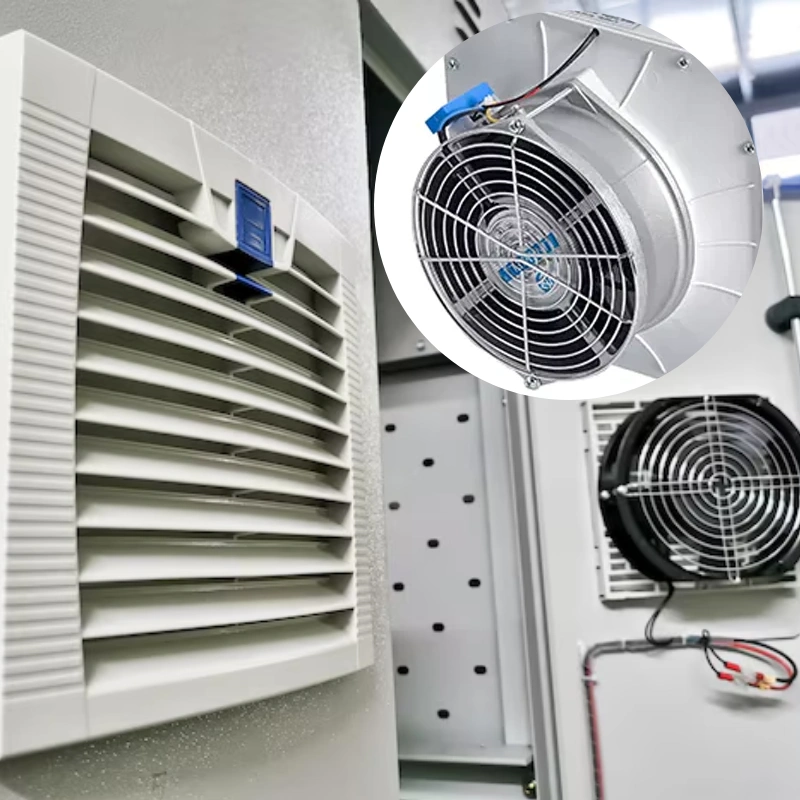 In terms of safety risk control, overheating of electrical cabinets may cause fires, with the probability increasing to 3%. However, the enclosure cooling fans that complies with the IEC 61439 standard can reduce the risk to 0.5%. For instance, referring to the major power outage in Texas, USA in 2021, the substation failed due to insufficient cooling. The system equipped with advanced fans has successfully withstood extreme conditions. The lifespan of a fan is typically 50,000 hours. In high-temperature and high-humidity environments, it can keep the humidity below 60%, reduce pressure loss by 15%, ensure compliance and lower the frequency of insurance claims.
Market trends show that with the advancement of Industry 4.0, the smart enclosure cooling fans integrates IoT sensors to monitor the temperature distribution in real time with an accuracy of ±0.5°C and a flow rate adjustable to 300 CFM. In the application of Siemens, this innovation has increased the equipment's load capacity by 25%. The peak temperature dropped from 70°C to 45°C. Consumer behavior surveys show that 80% of enterprises reported a 20% reduction in operating costs after installation, which has driven the global market size to expand at an annual growth rate of 8%, indicating that cooling technology will continue to optimize resource efficiency.
In terms of safety risk control, overheating of electrical cabinets may cause fires, with the probability increasing to 3%. However, the enclosure cooling fans that complies with the IEC 61439 standard can reduce the risk to 0.5%. For instance, referring to the major power outage in Texas, USA in 2021, the substation failed due to insufficient cooling. The system equipped with advanced fans has successfully withstood extreme conditions. The lifespan of a fan is typically 50,000 hours. In high-temperature and high-humidity environments, it can keep the humidity below 60%, reduce pressure loss by 15%, ensure compliance and lower the frequency of insurance claims.
Market trends show that with the advancement of Industry 4.0, the smart enclosure cooling fans integrates IoT sensors to monitor the temperature distribution in real time with an accuracy of ±0.5°C and a flow rate adjustable to 300 CFM. In the application of Siemens, this innovation has increased the equipment's load capacity by 25%. The peak temperature dropped from 70°C to 45°C. Consumer behavior surveys show that 80% of enterprises reported a 20% reduction in operating costs after installation, which has driven the global market size to expand at an annual growth rate of 8%, indicating that cooling technology will continue to optimize resource efficiency.
In terms of safety risk control, overheating of electrical cabinets may cause fires, with the probability increasing to 3%. However, the enclosure cooling fans that complies with the IEC 61439 standard can reduce the risk to 0.5%. For instance, referring to the major power outage in Texas, USA in 2021, the substation failed due to insufficient cooling. The system equipped with advanced fans has successfully withstood extreme conditions. The lifespan of a fan is typically 50,000 hours. In high-temperature and high-humidity environments, it can keep the humidity below 60%, reduce pressure loss by 15%, ensure compliance and lower the frequency of insurance claims.
Market trends show that with the advancement of Industry 4.0, the smart enclosure cooling fans integrates IoT sensors to monitor the temperature distribution in real time with an accuracy of ±0.5°C and a flow rate adjustable to 300 CFM. In the application of Siemens, this innovation has increased the equipment's load capacity by 25%. The peak temperature dropped from 70°C to 45°C. Consumer behavior surveys show that 80% of enterprises reported a 20% reduction in operating costs after installation, which has driven the global market size to expand at an annual growth rate of 8%, indicating that cooling technology will continue to optimize resource efficiency.
Próxima temporada 2025–2026
Viví el bosque antes que nadie
Reservá tu estadía y recibí personalmente la propuesta del equipo de conserjería.
Reservar mi estadía